THE IDOLATRY OF THE FAMILIAR:

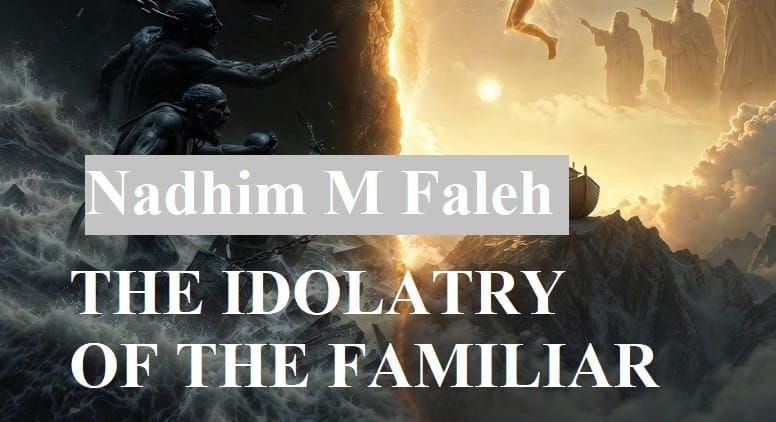
On Openness, Human Becoming, and the Inevitable Flood
In a recent reflection that stirred the quiet waters of thought, the author celebrated what he called our “cognitive superpower”, the rare and precious ability to seize new knowledge, discard what has grown stale, and embrace the ever-renewing current of learning. For those who possess an open mind in genuine pursuit of growth, he observed, this faculty is nothing less than a golden inheritance. I wish to carry the conversation deeper, not as rebuttal but as extension, by tracing two ancient yet urgently contemporary threads that bind this personal capacity to the grander architecture of divine law and the human story itself. What follows is offered in the spirit of literary meditation rather than polemic: two movements in a single symphony.
I. The Idolatry of the Familiar
To reject a new truth simply because it disturbs the settled furniture of the mind is to practice idolatry in its purest and most insidious form. The idol is not carved of stone or cast in gold; it is fashioned from habit, from ancestral custom, from the reassuring echo of “this is what we found our fathers doing.” History records the same tragedy in every age. When Noah stood before his people and called them toward an unfamiliar covenant, they answered with the ancient refrain: We see only the lowly among us following you. When Abraham shattered the idols of his kin, they demanded, Have you come with truth, or are you merely toying with us? And when Moses returned from the mountain bearing a law that demanded they abandon the golden calf of memory, the response was immediate and absolute: We shall remain devoted to it. In each instance the deeper refusal was not to a doctrine but to the discomfort of metamorphosis. The familiar had become sacred; the new, profane.
We witness the identical pattern today, dressed in the sophisticated garments of modernity. Political orthodoxies, economic dogmas, cultural liturgies, all have hardened into idols before which dissent is branded heresy. Challenge the prevailing narrative with fresh evidence and you are swiftly excommunicated as reactionary, dangerous, or naïve. Yet the divine pattern remains unaltered: every heavenly message arrives precisely to topple the old idol and raise the new truth in its place. The open mind, then, is no optional ornament of the intellect. It is the very condition of spiritual survival. To close it is to kneel before the most personal and therefore most tyrannical of gods, one’s own yesterday.
II. The Eternal Becoming and the Coming Schism
Human existence is not a fixed state but a perpetual becoming. Each season of life, childhood, youth, maturity, old age, requires the quiet death of what came before. The child must die for the youth to be born; the youth must dissolve so the adult may emerge. This is the law of completion, and it is never neutral. We evolve either toward the angelic or toward the abyssal. As understanding deepens with time, the soul reaches a fork of irreversible consequence. One path leads upward: the good within us swells until it lifts the human beyond the rank of angels, as when Adam was taught the names of all things and thereby exalted. The other path descends: the self grows so coarse, so degraded, that it becomes filthier than the devil himself. The obscene rituals of Epstein’s island stand as a contemporary parable, wealthy, cultivated men and women descending into bestial rites beneath the polished veneer of civilization, proving that refinement of taste does not guarantee refinement of the soul.
This personal trajectory, repeated across millions of lives, eventually rends the social fabric. Humanity splits along an invisible yet decisive fault line: one fragment ascending toward divine completion, constructing civilizations that honor both God and the dignity of the human; the other plunging into the worship of appetite, domination, and decay. When the fissure widens beyond repair, a flood of some kind, natural, social, or civilizational, becomes inevitable. The corrupt is swept away so that a remnant of the upright may begin again, exactly as occurred in the days of Noah. What we observe in our own turbulent era is not mere political polarization but the opening act of this primordial schism. Between those who still answer the call of new spiritual and moral truth and those who remain chained to the idols of materialism and unchecked desire, the divide grows daily more absolute. The individuals who cultivate the “cognitive superpower” of which the original post spoke are not merely the intellectually nimble; they are the ones aligned with the divine law of positive becoming. They will be the remnant that survives the coming waters. Those who cling to yesterday’s certainties, however venerable, will discover too late that they have chosen the path of descent.
Coda
The open mind is therefore far more than an intellectual virtue; it is an existential covenant. To accept new truth is to refuse idolatry. To keep ascending through the stages of becoming is to refuse the abyss. And when an entire civilization forgets these twin refusals, the logic of history, unchanging, merciless, and merciful, prepares the flood that will cleanse the earth and allow humanity to be reborn.